Showing posts with label chocolate. Show all posts

Thursday, November 21, 2024

The Rich Legacy of Chocolate in France

The history of chocolate in France is a rich and decadent narrative that traces its origins to the 17th century. Its arrival in 1615 marked a turning point in French culinary culture when Anne of Austria, a Spanish princess, introduced the exotic cacao drink to the French court upon her marriage to King Louis XIII. Reserved initially for royalty and the aristocracy, chocolate was savored as a luxurious beverage, symbolizing sophistication and opulence.

By the 18th century, chocolate had become a coveted indulgence among the French elite. This era saw the opening of Debauve & Gallais in 1800, Paris's first dedicated chocolate shop. Founded by Sulpice Debauve, chocolatier to King Louis XVI, the shop pioneered a cultural and gastronomic appreciation for chocolate that would thrive in France. It catered not only to taste but also to health, with Debauve creating chocolate pastilles for medicinal use.

The 19th century witnessed groundbreaking advancements in chocolate production. Jean-Antoine Brutus Menier, a prominent French chocolatier, revolutionized the industry by introducing mechanized production methods. The Menier Chocolate Factory became a hallmark of innovation, producing affordable and high-quality chocolate that expanded its appeal beyond the aristocracy to the growing middle class. This democratization of chocolate coincided with the Industrial Revolution, propelling France to the forefront of global chocolate production.
Modern France continues to uphold its reputation as a chocolate connoisseur's paradise. Renowned chocolatiers such as Pierre Marcolini and Patrick Roger push the boundaries of creativity, blending art with culinary expertise. Annual events like the Salon du Chocolat in Paris celebrate this enduring passion, showcasing innovations in flavors and sustainable production methods.

Today, French chocolate is synonymous with quality and craftsmanship, revered worldwide for its meticulous attention to detail. Whether enjoyed as a delicacy or gifted as an emblem of refinement, chocolate remains integral to France's culinary identity. Its journey from royal courts to global acclaim highlights not only its rich history but also the timeless allure of this beloved treat.
The Rich Legacy of Chocolate in France

Saturday, August 10, 2024

From Medicine to Confectionery: The Evolution of Panning

Panning, commonly associated with sweet treats today, has its roots in the pharmaceutical industry. The technique was first used over 1,100 years ago by the Persian physician Razes (Al-Razi), who sought to make pills easier to swallow by coating them with a mucilage—a sticky, plant-based substance. This innovation was a significant step in medicine, easing the ingestion of bitter remedies.

As time progressed, more palatable coatings were introduced. Sweeteners like sugar and honey were added to mask the unpleasant taste of medicines, making them more appealing to patients. This adaptation was crucial, as it not only improved the experience of taking medicine but also set the stage for the development of confectionery.

By the 12th century in Nîmes, France, this practice evolved further. The town became known for producing bite-sized, sweet-coated confections that were made using a method resembling modern-day panning. Although these early confections were crafted by hand, the basic technique involved repeatedly coating small items in layers of sugar—a process that laid the groundwork for the panning methods used in chocolate-making today.

The art of hand-panning continued for centuries until the 1840s, when the invention of the hand-turned pan revolutionized candy-making. This innovation marked the beginning of the transition from artisanal confectionery to the large-scale manufacturing industry we recognize today. The modern chocolate panning process has become increasingly sophisticated, with advanced machinery allowing for precise control over temperature, speed, and coating thickness. Yet, the fundamental process remains largely unchanged. Chocolatiers still use rotating drums to enrobe various inclusions, such as nuts or fruits, in layers of chocolate—a method directly descended from those early French confectioners.

Thus, panning’s evolution from a pharmaceutical necessity to a confectionery art highlights a remarkable journey, bridging medicine and the sweet treats we enjoy today.
From Medicine to Confectionery: The Evolution of Panning

Tuesday, January 31, 2023

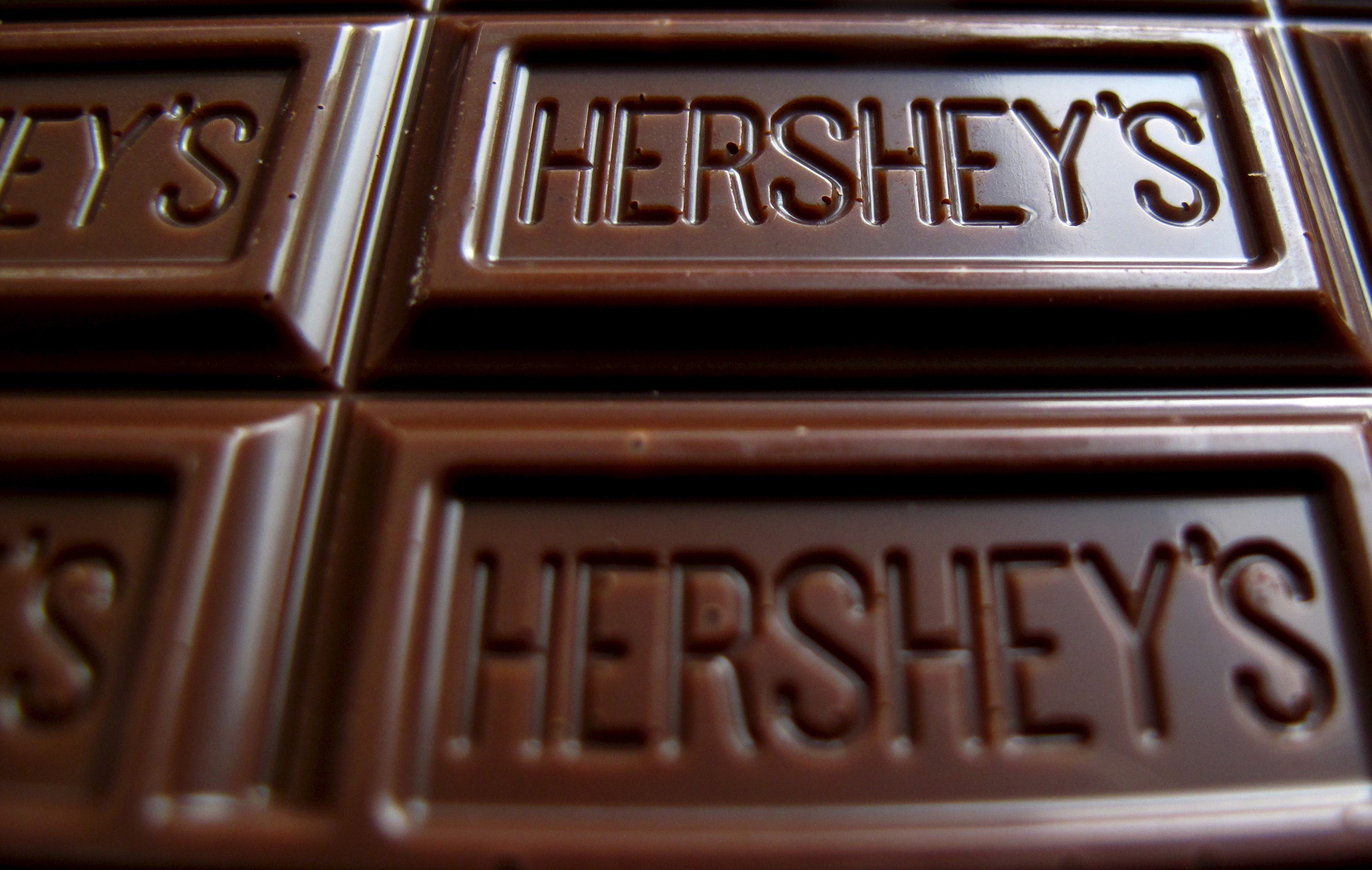
The history of Hershey’s Kisses

In 1893, after seeing and tasting chocolate from the World’s Columbian Exposition in Chicago, Milton Hershey immediately purchased the appropriate machinery and began applying chocolate coatings to his renowned caramels.

Prior to Kisses chocolates, Hershey had a molded product called Sweethearts. It was conical and had an indented heart shape on its base. Hershey’s Kisses Chocolates were first manufactured in 1907 by the Hershey Chocolate Company in Derry, Pennsylvania.

The bite-sized pieces of chocolate have a distinctive conical shape, sometimes described as flat-bottomed teardrops. In early production from 1907 to 1921, Kisses chocolates were hand-wrapped with foil and inside the foil wrapper was included a square of tissue paper that identified it as a Hershey’s product.

The Hershey Company created a machine that could automatically create the teardrop shape with a nozzle. Each Kiss could be plopped, one after the other onto a conveyer belt.

Hershe registering a trademark for the name “HERSHEY’S KISSES” in 1921. To counteract the sizable number of competitors, The Hershey Company (then known as Hershey Chocolate Company) developed wrapping machinery that could insert a visual product marker, a strip of paper called a plume, also called a tag or flag, in August 1921.

In 1924, Milton S. Hershey received a registered design trademark (Reg. 0186828) for "foil wrapped conical configuration with plume" which included the paper plume sticking out from the top of the aluminum foil wrapper.

Kisses Chocolates were in production from 1907 to 1942 and then not produced until 1947 due to rationing of aluminum during World War II. During that nearly six-year period, Hershey retooled its Kisses production equipment in order to produce chocolate D-Rations for the US Military.

In 1962 they began wrapping Kisses in red and green foils for the Christmas holidays. The pink and red Valentine varieties filling supermarkets this month were added in 1986.
The history of Hershey’s Kisses

Sunday, January 01, 2023

Chocolate and Johann Jakob (Jean) Tobler (1830–1905)

In 1867, Johann Jakob Tobler set up a small confectionery business in Berne, Switzerland. Nearly 50 years later the family business produced the Toblerone™ bar.

Jean Tobler was born on 18th March 1830. His Heimatort was Lutzenberg in canton Appenzell Ausserrhoden in Switzerland. He grew up in the municipality of Lutzenberg.

In 1867, Jean Tobler own his own confectionery shop, producing chocolate confectionery from products supplied from other manufacturer such as Suchard, Cailler and Sprüngli.

When Rodolphe Lindt also produces his new fondant chocolate in Bern in 1879, Tobler will be responsible for the distribution of the new chocolate for a few years.

In 1899 Jean Tobler with his sons Emil and Theodor founded Tobler & Cie. Located in Berne, Switzerland, the factory was called "Fabrique de Chocolat de Berne, Tobler & Cie." One year later, Jean handed over the business to his three children on 19th June 1900.

In 1908, Theodor Tobler and his cousin Emil Baunmann invented the world-renown Toblerone chocolate bar, a milk chocolate with a honey and almond nougat filling in a triangular shape. The product is combining Tobler's surname and torrone, the Italian word for honey and almond nougat.
Chocolate and Johann Jakob (Jean) Tobler (1830–1905)

Monday, September 12, 2022

The Hershey Company - One of the largest chocolate manufacturers in the world

Hershey Company, American manufacturer of food products, chiefly chocolate and sugar-based confections traces its origins to the 1880s, when Milton S. Hershey founded the Lancaster Caramel Company in Lancaster, Pennsylvania.

Following a four-year apprenticeship with a Lancaster candy maker, in 1873 Hershey established his first candy making business in Philadelphia. This shop was open for six years, after which Hershey apprenticed with another confectioner in Denver, where he learned to make caramel. Returning to Lancaster, PA in 1883, Hershey established the Lancaster Caramel Company, which quickly became an outstanding success.

After seeing German-made chocolate-processing machinery at the World’s Columbian Exposition of 1893 in Chicago, Hershey decided to go into the chocolate business. He bought the equipment for his Lancaster plant and soon began producing a variety of chocolate creations.

In 1894, he incorporates the Lancaster Caramel Company and establishes Hershey Chocolate Company as a subsidiary. Two years later, in 1896, Hershey built a milk-processing plant so he could create and refine a recipe for his milk chocolate candies.

In 1900 he sold the caramel company to a competitor and began the manufacture and launch of Hershey's Milk Chocolate bars. With mass production, Hershey was able to lower the per-unit cost and make milk chocolate, once a luxury item for the wealthy, affordable to all.

In 1903 he began construction on what was to become the world's largest chocolate manufacturing plant. The facility, completed in 1905, was designed to manufacture chocolate using the latest mass production techniques.

In 1907 began producing a flat-bottomed, conical milk chocolate candy that Hershey decided to name HERSHEY’S KISSES Chocolates.

In 1908 the Hershey Chocolate Co. was incorporated, and in 1927 it was reorganized as the Hershey Chocolate Corporation, a publicly traded company.

In 1921, Hershey begins using mechanical Kiss wrapping machine. Kisses are now wrapped with trademarked Plume. By 1931, 30 years after the company was established, Hershey was selling $30 million worth of chocolate a year.

By the end of the war, more than a billion Ration D bars had been produced and the company had earned no less than five Army-Navy “E” Production Awards for its exceptional contributions to the war effort.

During the 1960s Hershey bought the manufacturer of Reese’s Peanut Butter Cups and two pasta businesses. In recognition of its diversification, the company was renamed Hershey Foods Corporation in 1968. Today, The Hershey Company is the leading North American manufacturer of chocolate and non-chocolate confectionery and grocery products.
The Hershey Company - One of the largest chocolate manufacturers in the world

Tuesday, May 24, 2022

Philippe Suchard confectionery company

In 1814, Philippe Suchard started an apprenticeship in confectionary with his older brother Frédéric in Berne. In the year 1825 Suchard opened his first confectionery shop in Neuchâtel, Switzerland. He offered fine chocolate made by hand and laid the cornerstone for Suchard's success.

In 1826 he built his first chocolate factory in Serrieres, where he raised manufacturing standards and lowered prices. He invented various machines and devices. The one that is very important to the chocolate production is a special machine to mix sugar and cocoa powder to make the chocolate a homogeneous mass.

By 1833 Suchard was the largest chocolate company in Switzerland, producing half of the nation’s total production, employing approximately 250 people.

The Suchard Company opened its first plant outside Switzerland, in Lörrach, Germany, in 1880, the first in a series of international expansion efforts. In 1901 Suchard established the Milka chocolate brand, one of Europe's oldest and most popular brands of milk chocolate.

The Suchard and Tobler companies joined forces in 1970 to form Interfood, which Jacobs’ coffee company joined 12 years later to form Jacobs Suchard. The Tobler company began in 1867 when Jean Tobler, formally Johann Jakob Tobler, opened a small shop called Confiserie Spécial in Switzerland.

In 1990 Kraft General Foods acquired Jacobs Suchard, making it number one in the European roast and ground coffee market and a leader in confectionery.
Philippe Suchard confectionery company

Sunday, September 05, 2021

The arrival of cocoa in Europe

The first people known to consume the cacao beans were the Olmec, who lived in what is today southern Mexico.

The Olmec were followed by the Maya (of present-day Guatemala, Belize, and Yucatán Peninsula), and then the Toltec and Aztec of central Mexico. Each civilization valued the drink of the cacao bean. For the Maya, chocolate was a cocoa drink prepared with hot water and often flavored with cinnamon and pepper.

The early chocolate drink, considered a “drink of the Gods” was mixed with cinnamon and pepper, tasting bitter and strong.

In 1502, the first meeting of Western civilization with cocoa occurred: Christopher Columbus landed on the island of Guanaja, Honduras, and received the gift of a cup of Chocolate.

Cocoa appeared in Europe in 1528, when the Spanish conquistador Hernán Cortés brought samples of cocoa to King Charles of Spain, spreading the great effects of the beverage prepared from this “brown gold”.

In 1544, Dominican friars escorted Maya nobles to the court of Prince Philip of Spain, with cacao. The drink they made from it was bitter and flavored with unfamiliar New World spices.

Starting from 1660, the drinking of hot sweet chocolate spread across Europe: Belgium, Germany and Switzerland, and also Austria and Italy.

Francisco Hernández (c. 1517–1587) was among the first to consider the use of chocolate in connection with humoral medicine: he argued that as cacao bean had cold and dry qualities, chocolate had to be recommended to treat hot diseases, such as fevers.

It was in 1753 that the Swedish scientist Carl Linnaeus named the cocoa plant Theobroma cacao, from the Latin name Theobroma [literally ‘food of the Gods’], and the Aztec word xocolatl [i.e., xococ (bitter) and atl (water)].

In 1815 Conread Van Houten of Amsterdam island made cocoa butter from cocoa mass. He invented a special machine called the cocoa press. The cocoa press squeezed out a liquid from the cocoa nuts. This is called cocoa butter. Because of the machine, it was possible to make more chocolate and at a lower price.

The addition of milk to chocolate first occurred at the end of the 17th century, but Nestlè preparation based on condensed powdered milk by evaporation started in 1867, completely changing the taste of chocolate.

Milk chocolate was first made by Swiss Daniel Peter with condensed milk powder from Nestle company. He experimented for eight years before he finally produced the first milk chocolate in 1875. Milk chocolate is not as bitter as dark chocolate. Daniel Peter and his friend Henri Nestlé mixed condensed milk with chocolate

In 1879 Rudolph Lindt in Switzerland produced the first dark chocolate, by “conching”.

In 1905, Cadbury Dairy Milk was launched in the United Kingdom for it first sold products and now consists of a number of products. In June 1905 in England, Cadbury made its first Dairy Milk bar, with a higher proportion of milk.
The arrival of cocoa in Europe

Saturday, September 05, 2020

History of Belgian chocolate

Belgium is associated with high-quality chocolate products such as pralines and truffles, with brand names such as Godiva, Neuhaus and Leonidas recognized globally.

The history of Belgian chocolate reaches back to the 17th century, when Spanish explorers brought cocoa beans from South America. The Spanish nobility, who then ruled Belgium, enjoyed cocoa as a luxury drink. However, chocolate did not gain popularity with the general public until the second half of the 19th century, when Belgian King Leopold II colonized the Congo.

The first signs of chocolate trading in Belgium in 1635 in Ghent when the abbot of Baudeloo Abbey bought chocolate. Chocolate making was then mostly a sideline of pharmacists who sold it as a tonic.

While exports grew significantly between 1900 and 1930, Belgium was still importing more chocolate than it exported for much of this period. It was only since the 1960s that Belgian exports dominated imports. However, the success has grown rapidly in recent decades.

In 1840, Belgian chocolate maker Berwaerts sold the first pressed chocolate tablets, pastilles and figurines. It was around this time that several chocolate makers were founded that grew into large companies.

In 1857, Jean Neuhaus opened a pharmacy in Brussels, Belgium, where, among more traditional remedies, he sold bars of bitter chocolate. Eventually, the bars became so popular that Neuhaus focused his efforts on chocolate making. In 1912, Neuhaus’ grandson, Jean II, invented the now-famous Belgian praline by filling hard chocolate shells with soft cream or nut pastes.

In 1915, Louise Agostini, wife of Jean Neuhaus Jr, developed the first ‘ballotin’, a box in which pralines were packed.

The 20th century would mark the beginning of Belgium's status as a nation of elite innovators and manufacturers in the chocolate world.

Another important development was the introduction of the Belgian chocolate bar “batton” by Kwatta in 1920. Reducing the size of chocolate bars to 30g and 45g and making them into tablet shape further contributed to making chocolate an affordable snack. Chocolate spread was first sold by Cote d'Or in 1952. This delicious innovation rapidly gained popularity throughout the world between 1952 and 1958, as Cote d'Or featured this product as it's latest and greatest addition at the 1958 World's Fair in Brussels.

The Belgian chocolate sector boom started with the 1958 World Expo in Brussels. A major campaign was launched by both the government and the industry to boost Belgian chocolate worldwide.

Today, the Neuhaus company continues to manufacture Belgian pralines (known as bonbons elsewhere in the world), joined by other large manufacturers such as Godiva, Leonidas, and Guylian.
History of Belgian chocolate

Monday, September 30, 2019

Chocolate: History and origin

The origins of chocolate are very old, usually traced back to the Maya people, who were probably the first to cultivate the cacao plant, in 400 AD. They discovered that the seeds could be roasted, ground, and eaten. Maya Indians had created a chocolate drink by combining cocoa powder with water and spices.

The plant known today is the result of crossing and selection that had already started 35,000 years ago. Cocoa was first discovered by Europeans in South America. The Aztecs traditionally itself the seeds of the Theobroma cacao to make a drink by extracting the seeds from the cocoa pod and fermenting, drying and grinding them; the powder was then mixed with water. The Aztecs believed that the god Quetzalcoatl came to Earth on rays of light from the Star of the Morning,

In 1502, the first meeting of Western civilization with cocoa occurred: Christopher Columbus landed on the island of Guanaja, Honduras, and received the gift of a cup of chocolate.

It was cocoa as a drink that was imported by the Spaniards into Europe in the seventeenth century. A Spanish explorer by the name of Hernando Cortez helped Europeans begin to see that there was value in cacao beans. The great Aztec ruler Montezuma had served Cortez a drink made from cacao beans.

Until the 1600s and 1700s, chocolate was a luxury food for royalty and powerful church officials. But during the 1600s, people began grinding large amounts of cacao beans in mills, producing much more chocolate and lowering the cost. Starting from 1660, the drinking of hot sweet chocolate was spread across Europe: Belgium, Germany and Switzerland, and also Austria and Italy. In 1815, Van Houten developed a process for pressing a proportion of the fat from the dried powder in order to make it more palatable: at about 50% fat, the drink made from untreated cocoa must have been very heavy. Modern drinking cocoas, by contrast, contain only 20% or less of fat.

At first, the expressed cocoa butter must have been a troublesome by product with relatively low value. But by mixing the cocoa butter back with unpressed cocoa and sugar, it was possible to make an entirely new product, namely solid chocolate for eating. In 1875 milk chocolate made by Swiss Daniel Peter with condensed milk powder from Nestle Henry.

Chocolate: History and origin

Saturday, November 18, 2017

History of M&M

These candies were inspired by the chocolate candies the soldiers are during the Spanish Civil War from 1936 to 1937.

During the 1930’s, Forrest Mars, the son of the founder of Mars, Inc., established a chocolate manufacturing company in Chicago along with Bruce Murrie, the son of the president of the Hershey Company. Because both of their last names started with M, they called their new company M&M.

In 1940, they launched their first product, which they name M&M’s Chocolate Candies. Mars opened a factory in Brussels, hoping to sell Mars bars across Europe but the outbreak of World War II ended these activities.

M&M’s candies were popularized during World War II, when they were include in soldier’s rations. After the war, M&M launched print advertisements in national newspaper and magazines, ratio spots and bullboats.

Today, M&M’s varieties include peanut butter, almond, raspberry, mint, and pretzel.
History of M&M

Thursday, February 23, 2017

Affy tapple in history

In 1948 the first Affy Tapple was invented by the Kastrup family and their recipe was developed by Mrs. Edna Kastrup.

This was the first caramel apple in the United States with the tagline "The Original Caramel Apple!"

The Kastrup family opened the Affy Tapple store at Clark Street in Chicago in 1952.

They started as a fundraising tradition, selling it to local schools. In 1995 the company was sold to private investors.
Affy tapple in history

Wednesday, August 03, 2016

Perugina

Perugina is an Italian chocolatier and confectionery based in Perugia (Umbria), Italy. The company was founded in 1907, but it was acquired by Swiss-based multinational food and beverage company Nestle in 1988.

This company was founded by four partners, including Francesco Buitoni one of the founder of the Buitoni food company.  By 1922, the company employed about 400 workers, 300 of them women.

In 1922, the company launched its famous Bacio Perugina and between the wars expanded rapidly to become a leader in the sector of chocolate and sweets production.

Both Buitoni and Perugina expanded internationally in the 1930s, first to France and then to the United States with further expansion after World War II.

Perugina Chocolate House founded in Perugia in 2007, where visitors may discover the origins of chocolate, the black gold of the Maya; learn the art of chocolate making; and the history of the Perugina brand.

Perugina’s most popular products in the United States are its Baci, (which means ‘kisses’ in Italian), composed of chocolate and hazelnuts.
Perugina 

Sunday, February 21, 2016

Mozart chocolate (Mozartkugel)

Salzburg’s two main tourist attractions were its baroque architecture and its relationship with Mozart.

The invention of the chocolate Mozartkugel rapidly proved to be the ultimate form of tourist souvenir-cum-advertisement.

Mozart chocolate or Mozartkugel is a delicious candy created in 1890 by Salzburg confectioner Paul Furst to honor Salzburg’s famous musician, Wolfgang Amadeus Mozart.

At first, the confectioner called them ‘Mozartbonbon’ and only later by the name which they are known world-wide today: Mozatkugeln.

When Fürst presented his sweet creation at a Paris fair in 1905, he was awarded a gold medal. The chocolate-covered Mozartkugel have a center of marzipan mixed with pistachio nuts.
Mozart chocolate (Mozartkugel)

Thursday, December 17, 2015

The first chocolate manufacturing plant in United States

In 1730, chocolate manufacturing becomes a mass production when a mechanical cocoa grinding process is introduced.

Chocolate production in the United States grew faster than anywhere else in the world. The first wholly machine-made chocolate was produced in Barcelona, Spain in 1780.

It was during pre-revolutionary New England – 1765 the first chocolate factory was established in America. It was first manufactured in 1765 by Irish-born chocolatier John Hannon and physician James Baker. They opened the first chocolate factory at Milton Lower Mills, near Dorchester, Massachusetts.

John Hanan brought the cocoa beans from the West Indies, thinking they might be used in medicine. In 1780 James Baker produced chocolate made soluble by a reduced cocoa butter content, a product called baker’s chocolate.

James Baker’s descendent Walter Baker hired an employee named Samuel German, who developed a sweet chocolate; which was added to the Baker’s line under Germans name.

In the 1900s, Milton S. Hershey worked zealously at preparing recipe that would compete with the Swiss until he finally came out with a formula which mixed the right combination of sugar and cocoa.

This was amazingly popular with the public that he began to mass produce and distribute chocolate candy very successfully.
The first chocolate manufacturing plant in United States

Tuesday, December 01, 2015

Invention of Van Houten chocolate processing

In 1815, Coenraad Johannes van Houten (1801-1887), a Dutch chemist, began work on his Amsterdam factory on a process that would revolutionize the manufacture of drinking chocolate while paving for eating chocolate.

In 1828 he patented a press that removed most of the bitter fat, which accounts for more than half the weight, from the ground, roasted beans. He pioneered a pressing process for milling cocoa he removed the center of the bean –called nib – in order to make the resulting paste more digestible.

Van Houten also went on to treat the coca with alkaline salts to improve it blending with hot water. This process is known as ‘Dutching’. The process made its cocoa essence more soluble and more ‘chocolatey’ in taste.

For the first time, cheap chocolate powder could be produces for the masses. Ten years after he had patented the process van Houten sold the rights to his cocoa press. One of his first customers was J.S Fry & Sons of Bristol, England.

Van Houten established a new steam-powered factory in 1850, close to Amsterdam.

Van Houten sold his cocoa to candy makers, housewife and bakers. In 1877, C.J van Houten and Zoon, of Weesp, Holland applied for a British trademark, which was registered for Van Houten’s Pure Soluble Cocoa until 1989.

The English firm of Cadbury reproduced the technology of van Houten and quickly became the leading British confectioner, due to its marketing strategy of connecting boxes of chocolate candies to romance: boxes of chocolates were demanded by men to be given to their special lady friends.
Invention of Van Houten chocolate processing

Wednesday, September 16, 2015

Asher’s Chocolates

Chester A. Asher, a Scottish emigrated from Canada in 1890 and founded the business two years later. His started his candy business in 1892. The factory was in the center city of Philadelphia.

In an effort to capitalize on its popularity, in 1898, the firm relocated to the Germantown section of the city. Asher’s Chocolates remained in Germantown for more than nine decades, expanding over the years to occupy several buildings.

By 1910, he built a three storey brick juice factory juice behind his store and candy production factory.

Chester A. Asher’s four sons ran the company until 1966, when third generation Asher’s John L. Jr. and Robert took over.

The company slowly declined until it was declared to be ’tw0 weeks from bankruptcy’ in 1966. The third generation Asher aggressive sales and production program, the company produced sand sales more than 3.33 million pounds of candy.

By 1997, Asher’s Chocolate generated between $20 million and $25 million in revenues.

In 1998, the company moved its factory, shipping and offices to a new 125,000 square foot facility in Souderton.

Robert and Jack Asher, and great-grandsons David and Jeff Asher, who are cousins, co-own the business today.  Today Asher’s Chocolates employs 250 people, 180 at the Souderton location, who produce 8,000,000 pounds of candy per year.
Asher’s Chocolates

Thursday, April 30, 2015

History of Nestle KitKat

Rowntree had been making chocolate in York since the 1860s. 

KitKat product was developed as a four-finger wafer crisp, initially launched in London and the South East in September 1935 as ‘Rowntree’s Chocolate Crisp’ and re-named two years later as KitKat Chocolate Crisp.

Within two years of launch, KitKat chocolate was established as Rowntree’s leading product a position that it has maintained ever since.

It remained popular in the UK, despite weathering the storm of the Second World War. It became KitKat after the Second World War KitKat was first advertised in TV back in 1957 and had its first color advert in 1967.

In 1988, Nestlé SA acquired Rowntree. Nestle boosted Rowntree’s international presence, selling its brands in territories that had been beyond its reach before.

KitKat which for so many years was the best-selling selling chocolate bar in Britain became a huge seller in India, China and Eastern Europe.

KitKat is produced at the Nestlé Rowntree Factory and in 2004 a massive 39,000 tons of KitKat were sold.

By 2010, KitKat was sold in more countries than any chocolate bar, with 17.6 billion of the chocolate fingers produced very year.
History of Nestle KitKat

Thursday, January 08, 2015

History of Klondike bar

Klondike bar consists of a vanilla ice cream square encased in a layer of chocolate on the outside.

It was invented in about 1922 by the Isaly family, who owned the Mansfield Pure Milk Company in Mansfield, Ohio. William Isaly created a thick, square slab of vanilla ice cream covered in Swiss chocolate, and his ice cream novelty became enormously successful under the trademark name of Klondike bra.  It’s named after the Klondike River of Yukon, in the Canadian Yukon Territory that was made famous by the 1890s gold rush.

Opening their first ice cream parlor at the corner of Mulberry and Fourth they soon expanded to several other parlors in Mansfield and on other cities. At its height of popularity, during the 1930s, 1940s, and 1950s, virtually every town in Ohio and the surrounding states had an Isaly’s store.

In 1993, the Isaly Klondike Company was acquired by Unilever and it was folded into a subsidiary, which also sold Good Humor bars and Breyers ice cream.
History of Klondike bar 

Tuesday, December 30, 2014

Fondant chocolate

The chocolate fondant cream is proudly Anglo-Saxon. Fondant is initially soft and is shaped and hardened on starch moulds. These are shallow trays filled with an edible starch based on cornflour.

Fondant chocolate was first developed in 1847. It happened when Englishman Joseph Fry and his son introduced solid ‘eating chocolate’ through the development of fondant chocolate, a new velvety version.

The result was the first molded chocolate bar. Joseph Fry and Sons started selling its Chocolate Cream Bar (fondant coated with dark chocolate) in 1866.

In 1870s, pharmacist Rudolph Lindt invented soft fondant chocolate. He had invented a special blend of his liquid chocolate paste, which not only was exquisitely tasteful but also as ’chocolate fondant’ melted when consumed.

When eaten this new soft chocolate it melted on the tongue and possessed a very appealing aroma.
Fondant chocolate

Saturday, December 13, 2014

First chocolate bar by Fry & Sons

Chocolate was primarily served as a drink or an ingredient in recipes until 1847.

Back in 1830, British candy makers J.S Fry and Sons developed the world’s first chocolate bar by roasting fermented cacao pods and then grinding them into a fine paste that could be separated into either cacao solids or cocoa butter.

J. S. Fry & Sons Limited was owned by Joseph Storrs Fry and his family. The company experimented with the ‘Dutched’ chocolate adding sugar and some of the cocoa butter and molding the mixture. They produced and commercialized the first plain chocolate bar in 1847 meant for eating as a snack.

Fry & Sons advertised it as ‘Chocolat Delicieux a manger’ (or Chocolate delicious to eat). In 1861 Richard Cadbury creates the first know heart-shaped chocolate box for Valentine’s Day.

The company later merged with Cadbury to form Fry Cadbury in 1919.
First chocolate bar by Fry & Sons

THE MOST POPULAR POSTS