Showing posts with label Egyptian. Show all posts

Friday, April 18, 2014

History of oregano

Oregano’s name comes from the Greek word oros ganos, meaning joy of the mountain.

Mediterranean oregano was originally grown extensively in Greece and Italy. Records on the use of oregano date back thousands of years: famous ‘hyssop’, mentioned in the Bible, is believed to be an Origanum syriacum L. plant.

Originally used to flavor ale and beer in Europe, oregano is an essential spice in Italian pizzas, Tex-Mex chili con carne, and Mexican beans. Early brewers used oregano in their beer to disguise off flavors before they discovered hops. 

The ancient Greek and Egyptians used oregano to flavor fish, meats, vegetables and wine.

Pliny, the ancient Roman scholar, recommended oregano poultices for scorpion and spider bites.

As early as the 1400s, oregano had a variety of medicinal, cosmetic and household uses. It was used as a palliative for headache, rheumatism, colic, upset stomach, cough and scurvy.

Before World War II, oregano was almost unknown in the United States. However, its popularity skyrocketed with the popularity of pizza.
History of oregano

Monday, February 24, 2014

Ancient history of watermelon

Watermelon has been widely consumed, particular in Mediterranean countries and in Egypt, where it frequently plays an important role when water is polluted or in short supply.

The Egyptian tombs depict the culture and eating of watermelons reaching back at least 4000 years. It was customary for peasants to offer watermelon to thirsty voyagers.

The first archeological evidence for watermelons in northern Africa was a few seeds found in the tomb of Tutankhamen in Egypt.

Watermelon is described in Sanskrit and Arabic literature, but seems to have been unknown to ancient Greek and Latin writers.

The watermelon became known in China and eastern Russia around the 10th century and in Britain around 1600. It was brought to the New World in the 1500s.
Ancient history of watermelon

Friday, August 31, 2012

History of herbs and spices in ancient Egypt

As long as 3500 BC, the ancient Egyptians were using local spices to flavor their food, in cosmetics and in lotions for embalming their dead.

Egyptian papyri recording the medical uses of herbs, dating from 2800 BC. Papyrus is a kind of paper made from reeds. Some of the scrolls were more than 6 feet long.

The Egyptians in the days of Pharaohs had developed great skill in the use of herbs. The Ebers Papyrus listed 876 herbal formals from more than 500 plants. This present about one-third of the herbs in today’s western herbal pharmacopoeia.

One of the first world physician name Imhotep made medicine from plants and use these remedies to treat people suffering from appendicitis, arthritis and other ailments.

By the time the Ebers papyrus was recorded, Imhotep was worshipped as a hero, as a blameless physician and later still as the god of medicine.

There were many different types of herbs and spices used in ancient Egyptian cooking. The herbs and spices enhanced the flavor of the dishes, but also acted as preservative.

Aromatics woods such as frankincense were burned as incense to purge unpleasant odors and fumigate homes.

While most of cooking used including cumin, coriander, fennel, anise and poppy seed, would have been plentiful locally, there is evidence that by the second millennium BC other spices were already being bought from overseas.

The Egyptians believed that garlic and onion strengthened the body and prevented disease. They ate a lot that the Greek historian Herodotus called them ‘the stinking ones’. They gave their slaves daily rations and onions to keep them string and healthy.

In Egypt the dividing line between medicinal and cosmetic recipes was often blurred. The priests, controlled the manufacture of the substances were also in charge of the offerings of incense and fragrant oil in the temples.

They also in charge the precious ointments that were used for embalming the bodies of high ranking Egyptians. Most of the herbal spices originated in Mediterranean countries and have been used since ancient Egyptian times mainly for the purpose of embalming.

Egyptian medicine was exclusively disease centered rather than person centered.

By the time of Ramses II (1304-1237 BC) Egyptian ships were sailing into Persian Gulf as far as the Euphrates. Egypt then became a lucrative market for spices from further and further afield.
History of herbs and spices in ancient Egypt

Friday, May 30, 2008

Egyptian Farming and Food in 1300 BC

Egyptian Farming and Food in 1300 BC
Harvest of the fertile River Bank
Neat parcels of farmland bordered the Nile, and it was there that nearly all Egyptians worked. The boundaries between farmers’ fields were marked with special stones, and during the annual inundation the Nile’s water obliterated all landmarks except the stones. The dishonest farmer then had an unparalleled opportunity to move boundary stones in his favor, but stealing precious land in this way was one of the worst sins an Egyptian could commit.

When the river water started to recede, the farmer’s first tasks were to reinstate any migrant boundary stones, and to repair flood damaged to dykes. The Egypt’s yearly round of cultivation began in earnest. Peasants with digging sticks broke up the larger clods of earth: then came ox-drawn ploughs followed by sowers scattering seed by hand, and sheep or goats to tread the seed in.

Growing season
During the growing season, the farmers worked hard weeding and watering the crops. They also help to protect them from birds, and from straying cattle and even the hippopotamus.

Egyptian most important crops were wheat and barley, and flax which they grew for linen and linseed oil. Grain was harvested in March or April. All work in the fields and the threshing floor was a communal effort, and land owner provided musicians to play flutes while peasants worked.

End of the Season
The beehive-shaped silo each stored one type of grain, and a small farm would have several of them. Then everyone celebrated in honor of Renenutet, guardian goddess of harvest. The middle of March marked the beginning of the summer season of drought and heat. During this period it was vital to repair any damaged irrigation canals before the soil dried out and became too hard to dig. For a few weeks farmers enjoyed a brief rest before the floods came again.
Egyptian Farming and Food in 1300 BC

Sunday, January 28, 2007

History of Bread

Food History
Bread is the oldest and most important baked product. It has been made from many of the grains, including wheat, corn, rye, rice, barley, oats and even buckwheat. Bread, in one form or another, has been one of the principal forms of food for man from earliest times.
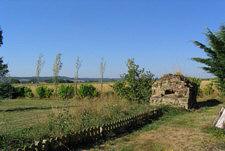
Wheat has been found in pits where human settlements flourished 8,000 years ago. The ancient Greeks and Romans knew bread for a staple food even in those days people argued whether white or brown bread was best.

Further back, in the Stone Age, people made solid cakes from stone-crushed barley and wheat. A millstone used for grinding corn has been found, that is thought to be 7,500 years old. The ability to sow and reap cereals may be one of the chief causes, which led man to dwell in communities, rather than to live a wandering life hunting and herding cattle.

When ancient man discovered a food that would keep through the winter months, and could be multiplied in the summer, it could be said that civilization began. He might have a reasonably safe store of food to carry him over, which would give him time to develop other useful skills besides hunting, fishing and cattle-herding.

Bread was leavened; that is, an agent in the form of a 'barm' was added to the dough that caused the mixture to rise in the shape of our familiar loaf. The hurried departure of the Israelites from Egypt, described in the Book of Exodus in the Bible, prevented their bread being leavened as usual; the Jews today commemorate this event by eating unleavened bread on special occasions.The ruins of Pompeii and other buried cities have revealed the kind of bakeries existing in those historic times. There were public bakeries where the poorer people brought their bread to be baked, or from which they could buy ready-baked bread.
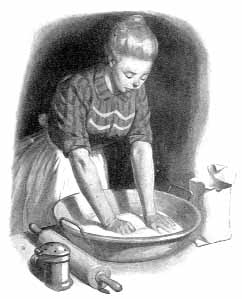
The bakers in Rome at period 168 BC enjoyed special privileges: they were the only craftsmen who were freemen of the city, all other trades being conducted by slaves.

The Greeks and Romans liked their bread white; color was one of the main tests for quality at the time of Pliny (AD 70). Those who think the craze for white bread is a modern fad should note this. Pliny wrote, "The wheat of Cyprus is swarthy and produces a dark bread, for which reason it is generally mixed with the white wheat of Alexandria". Plato (c. 400 BC) pictured the ideal state where men lived to a healthy old age on wholemeal bread ground from local wheat. Socrates, however, suggested that this proposal meant the whole population would be living on pig-food. In those days, there were certain bakers who kneaded the meal with seawater to save the price of salt. Pliny did not approve of this.

The Romans enjoyed several kinds of bread, with interesting names. There was oyster bread (to be eaten with oysters); 'artolaganus' or cakebread; 'speusticus' or 'hurry bread'. There was oven bread, tin bread, and Parthian bread. There were rich breads made with milk, eggs and butter, but these of course, were only for the wealthy and privileged people. The Egyptian grammarian and philosopher Athenaeus, who lived in the third century AD, has handed down to us considerable knowledge about bread and baking in those days.

He wrote that the best bakers were from Phoenicia or Lydia, and the best bread-makers from Cappadocia. He gives us a list of the sorts of bread common in his time-leavened and unleavened loaves; loaves made from the best wheat flour; loaves made from groats, or rye, and some from acorns and millet. There were lovely crusty loaves too, and loaves baked on a hearth. Bakers made bread mixed with cheese, but the favorite of the rich was always white bread made from wheat. In ancient Greece, keen rivalry existed between cities as to which produced the best bread.
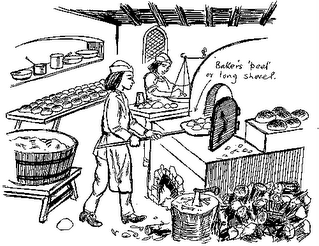
In early English historical times, there were constantly recurring periods of famine, due to not enough, or too much rain, or frosts, and other natural causes. The ruling classes, knowing that rebellion often followed famine, did their utmost to keep the price of bread from rising too high. Laws regulating its price were passed during the reign of King John (1202). Not only did the law fix the price, but also it strictly allocated that price between cost of material and an allowance for necessary charges to the baker.
Food History

THE MOST POPULAR POSTS