Showing posts with label Roman. Show all posts

Monday, November 01, 2021

Ancient wheat process of milling

It is generally believed that wheat had its origins in the regions of the ancient Eastern region of Egypt, Mesopotamia and the Levant, around 7000 B.C, although it had likely been gathered as a wild grain much earlier.

The grain was placed in a large saucer-shaped stone, a smaller rounded stone was used to crush it. Saddle querns seem to be the most common cereal grinding tools through all prehistory and early history of Mesopotamia and the Mediterranean.

The process of milling wheat into flour was revolutionized around 800 BC in Mesopotamia, when animal, water and wind power were harnessed for the first time to run the large stones used for grinding.

These mills were often constructed using good quality stones, the grinding process could have been repeated several times and finally flour was sieved.

In ancient Rome the mill and the bakery were the very same enterprise. The grains were milled and worked up without delay to dough and bread.

In the Middle Ages the milling of four became the monopoly of a few professional millers who were granted this concession by the wealthy landholders who built the large mills.

The first wind-powered mills were built in England in the 11th century, and in Belgium Luxemburg and the Netherlands in the 12th century.
Ancient wheat process of milling

Friday, May 07, 2021

Fruit of fig in ancient history

The fig tree, which is closely related to the sycamore, is one of the humanity’s oldest cultivated plants dating back archeologically to Jericho (c. 7000 BC).

According to the Jewish Talmud, figs were the first nourishment of human beings, and they were equally important to the ‘idol worshippers’ in neighboring Egypt. Wine and figs had a significant interrelated ritual significance.

Fig was dedicated to Bacchus and employed in religious ceremonies. In the Olympic Games, winning athletes were crowned with fig wreaths and given figs to eat.

As early as the fourth century B.C., Theophrastus reported that most good fruits, including the fig, had received names. Ulysses, the hero of the Odyssey, obtained from his father twenty fig trees, all with names.

Ovid, the Roman poet, states that figs were offered as presents in the Roman celebration of the new year.

Flavius Josephus named the fig the ‘king of all fruit’ and it was considered the ‘sister of the grapevine’ (Hipponax). In ancient Greece, the fig was considered a gift from earth mother, Demeter.

Pliny the Elder in his Natural History extolled "One hundred and eleven observations" on the fig. Among them, "This fruit invigorates the young, and improves the health of the aged and retards the formation of wrinkles," and “Mixed with axle-grease it (fig milk) removes warts."

Pliny listed names of figs and gave the color of mature fruits, but did not describe varieties in detail.
Fruit of fig in ancient history

Saturday, February 13, 2021

History and origin of apples

Its primary wild ancestor is Malus sieversii whose range is centered at the border between western China and the former Soviet Union originated 4000 to 10000 years ago. This species is diverse and wild trees bearing the full range of forms, colors, and tastes are found in Kazakhstan and other independent countries of Central Asia formed from the breakup of the Soviet Union.

The cultivated apple then underwent hybridization with its wild relatives during its spread from the Tian Shan Mountains westward along the Silk Route.

Apples were certainly one of the earliest fruits to be gathered by people, and their domestication was probably preceded by a long period of unintentional planting via garbage disposal.

Based on combined archaeological and molecular data, it seems likely that, in the late Neolithic or early Bronze Age, travelers on the great trade routes that ran from central China to the Danube, carried the seed of the Central Asian wild apple west, either in saddle bags or horses’guts.

It was known to the Greeks and Romans and mentioned by Theophrastus in the third century BC. It is difficult to determine exactly when the apple was first domesticated, but the Greeks and Romans were growing apples at least 2,500 years ago. They actively selected superior seedlings and were budding and grafting 2,000 years ago.

Grafting is a practice that is thought to have begun about 3800 years ago based on a cuneiform description of budwood importation for grape in Mesopotamia. Indirect evidence has been obtained for the cultivation of apples 3000 years ago in Mesopotamia.

The Romans probably learned apple grafting, cultivation, harvesting, and storage from the Greeks, and brought the production chain technology to the rest of their empire.

The Romans brought the whole package to Western Europe and, for the last 2000 years, the domesticated apple has diversified and flourished worldwide. It was dispersed to the New World by European settlers during the sixteenth century.

During the late nineteenth and twentieth centuries, M. domestica cultivars found or bred in Europe, Russia, North America, New Zealand, Japan, and Australia were introduced throughout the world and form the basis for most current commercial apple production.
History and origin of apples


Sunday, September 13, 2020

Ancient history of pomegranate fruit

Pomegranate are originated from central Asia. Pomegranate has an important place in the ancient cultures of the Mediterranean countries. It was cultivated in ancient Egypt and in early Greece and Italy. The fruit which was described by the Greek botanist Theophrastus about 2350 years before the present (BP) and is mentioned in many Greek and Turkish myths.

Edible pomegranates were firstly reported to be cultivated in Iran during 3000 BC. It was recorded that pomegranate cultivation in about 2200 B.C comes from the ancient civilization of Sumer, located in the lower Tigris and Euphrates valley, approximately the area of present-day Basra, Iraq. It is believed that the pomegranate was brought into the area by people who were migrating from the Zagros Mountains— on the present-day Iran and Iraq border.

Phoenicians established Mediterranean Sea colonies in North Africa and brought pomegranates to Tunisia and Egypt by 2000 BC. The Phoenicians were great traders who sent many ships to ports in the Mediterranean Basin.

During that time, pomegranates also naturalized around the world and reached China by 100 BC over the Silk Road.

It was probably introduced into Greece and the areas surrounding the Mediterranean Sea, as far west as Spain and Portugal by ancient sailors and traders.

Ancient traders in Central Asia and the Middle East referred to the pomegranate as the “fruit of paradise.” Arabian caravans carried the fruit with other trade goods and spices, as well as the water and food they transported to provision the travelers.

Cultivation of the pomegranates in the Roman Empire and Spain is estimated to be in 800s. It was introduced in the Indian Peninsula from Iran during the 1st century AD and was found growing in Indonesia in 1416 AD.

The Spanish sailors brought pomegranates to the New World and some missionaries introduced pomegranate in Mexico and California. The first clear evidence that the pomegranate was in the area to become the United States was in the early 1700s, when they were grown in Spanish Florida and English Georgia.
Ancient history of pomegranate fruit

Sunday, August 02, 2020

Onion in Greek and Roman

Onion probably acquired its name from the city built by ONIA in 1703 B.C. near Gulf of Suez. Onion is believed to have originated in Central Asia, possibly in Iran- Pakistan region. Onions have been revered not only for their culinary use, but also, for their therapeutic properties.

Ancient Sumerians widely grew and cooked onions 4000 years ago. Onion was popular with the ancient Greeks and Romans for seasoning of foods. The pungency of onions made them popular among poor people throughout the world who could freely use this inexpensive vegetable to spark up their meals.

Ancient Greeks were aware of the numerous health benefits of consuming onions, so athletes ate them frequently and in large amounts. In order to firm up their muscles, Roman gladiators were rubbed down with onions as well. Romans also believed in benefits of onion-eating such as helping soothe toothaches or insomnia. The Romans felt the concentric circle configuration of the onion represented eternity.

Additionally, the ancient Greek physician Hippocrates wrote in the fifth and fourth centuries B.C. that a broad variety of onions were eaten regularly in Greece. He suggested onion as a diuretic, laxative, and emmenagogue. He also used onion for the treatment of pneumonia, and, externally, for healing putrid wounds.

When the Romans introduced the onion in Europe it quickly became a popular vegetable. Despite protracted social and religious taboos through the centuries, the onion has gradually regained respectability.

Scientific research on these plants started in the second half of the 19th century with the work of Louis Pasteur that in 1858 first noted antibacterial properties of garlic. Later on, in 1932 Albert Schweitzer treated amoebic dysentery in Africa with garlic.
Onion in Greek and Roman

Tuesday, July 28, 2020

Ancient history of turnip

Brassica is the Latin word for cabbage, rapa means turnip, and campestris refers to “of fields” in Latin.

The turnip was first developed by prehistoric man around two thousand years ago for its enlarged root. It is difficult to trace its origins to an exact location, but it is believed to have first been cultivated in Northeastern Europe or Western Siberia. By 300 B.C., turnips were domesticated and grown in Greek civilizations.

The word laptu in ancient Assyrian dates back to 1800 B.C. The turnip is a very well-known vegetable in the entire Middle East. In Ancient Greece and Rome, the turnip was an important domesticated crop plant and they thought highly of the turnip and developed several new varieties.

The Greek Theophrast (371 - 285 B.C.) called it gongylis and the Roman Columella (35 - 65 A.D.) distinguished between the cultivation and conservation by lactic acid fermentation of napus and rapa, saying that napus only forms a tender root, whereas rapa has a thick stomach.

Pliny (23 - 79 A.D.), an ancient Roman author, used the names rapa and napus to describe turnips that were long, flat, or round. He described the varieties in ancient Rome, showing that the turnip was a favorite crop in mountainous regions of the Apennine and the Northern parts of Italy.

In addition to being appreciated for their food value, they have been used as a wrinkle remover by the Romans, and as a treatment for frostbite, gout, measles, and arthritis.

English of the Middle Ages turned napus into naep in Anglo-Saxon. In the Middle Ages the turnip was a staple food plant. In the Capitulare de Villis, Charlemagne (around 800 A.D.) gives instructions on which crops had to be planted and had to be given to his court; among those listed is napi. Hildegard von Bingen (1098 - 1179 A.D.) uses the term ruba and Albertus Magnus (1193 - 1280 A.D.) distinguishes napo and rapa.

Turnips were introduced into North America by early European settlers and colonists. They grew well in the South and became a popular food of this region. Turnip greens, which became an integral part of Southern African-American cuisine, are thought to have been adopted into this food culture because of the role they played during the days of slavery.
Ancient history of turnip

Sunday, July 26, 2020

History of black pepper

Black pepper is one of the oldest spices used by man. It has been traded since 1500 BC.

When Alexander conquered Egypt in 332 BC, he created the major trading center for spices coming from the Orient and bound for Europe: Alexandria on the Mediterranean coast of Egypt - and it was here that western spice traders met with African and Asian spice merchants. Exotic spices such as cinnamon, cassia, black pepper, ginger and many others traded hands from Arabs to Greeks over the centuries at this Mediterranean port city - spices coming by caravan from India, China and Southeast Asia.

The earliest travelers from Europe who visited India described pepper cultivation on the Malabar coast. Theophrastus, the Greek philosopher (372-287 BC) mentions two kinds of pepper in the fourth century B.C., (most likely these were black pepper and long pepper), both of which were used by the Greeks and the Romans. It was one of the first commercial trade products between the East and Europe.

Pliny, in some early written reports, mentioned even about the price of pepper at that time. According to him, the price of long pepper was 15 Dinaries, white pepper 7 Dinaries, and black pepper 4 Dinaries per pound. During his time, Rome developed an active spice trade with Saudi Arabia and India.

During Pliny’s time Rome developed an active spice trade with South Arabia and Somaliland and, by direct route, with India. In the Roman Empire the consumption of spices as food condiments soared.

Discorides in the first century A.D. mentions black pepper and long pepper as well as white pepper, which is simply black pepper seed with its peel or pericarp removed. Black pepper and long pepper were among the spices from India on which the Romans levied import duty at Alexandria, around A.D. 176.

Pepper is mentioned by Roman writers in the fifth century A.D. It is said that Attila the Hun demanded, among other items, 3,000 lbs. of pepper as ransom for the city of Rome.

Centuries later, the high cost of pepper led the Portuguese to seek their own sea passage to India. The Portuguese were successful in this mission and monopolized the spice trade until the 18th century. Round or black pepper began to compete with long pepper in Europe beginning in the 12th century and had replaced it by the 14th century.

The British founded their East India Company in A. D, 1600. Two years later the United East India Company of the Dutch was formed. Their entry in this field increased rivalry in spice trade. Between A.D. 1605 and 1621, the Dutch managed to drive the Portuguese out of the Spices Island achieving a monopoly in spices trading.

In January 1793, an agreement was made between the Rajah of Travancore and the Crown of England. The Rajah was to supply large quantities of pepper to the Bombay Government in return for arms, ammunition and European goods. This is known historically as the “Pepper Contract”.

From the 16th to the 18th centuries, the struggle for control of the Far Eastern spice producing regions became so intense that wars were fought between Portugal, Holland, and England. By the end of the 18th century, the United States entered the world trade for spices, bartering its salmon, flour, and soap for tea, coffee and spices.
History of black pepper

Monday, August 13, 2018

History of Pretzel

Pretzel can be traced back to Roman times and they have long been traditional in Alsace and Germany.

Pretzels were developed as an option to satisfy abstinence and fasting laws of the time. Eggs, fat, and milk were forbidden during Lent. So, the remaining ingredients that one could use included water, flour, and salt. A young monk baked the first pretzel —making a Lenten bread of water, flour, and salt, forming the dough into the prayer position of the day, and baking it as soft bread. These first pretzels would have been much like the soft pretzels.

Pretzels are glazed, salted biscuits shaped into long tubes that are often twisted into knots. The word “pretzel” derives from German, but the Dutch may have first introduced pretzels into America. There is a story that in 1652 a settler name Jochem Wessels was arrested for using good flour to make pretzels to sells to the Indians at a time when his white neighbors were eating bran flour.

The first mention of the word pretzel in American print was around 1824. Homemade pretzels were sold by street vendors and in the 1861 the first commercial company was launched by Julius Sturgis in Lititz, Pennsylvania.

In 1933, the Reading Pretzel Machinery Company invented the first machine that could bend pretzels. Before 1933, pretzels were hand twisted or partially twisted using a cracker cutting machine.
History of Pretzel

Tuesday, December 27, 2016

London Central Markets (Smithfield)

Smithfield is located northwest of St. Paul’s Cathedral, between Aldersgate Street, Holborn Viaduct and Farringdon Street.

Smithfield is central London’s last surviving meat market. The name ‘Smithfield’ appears to come from ‘Smoothfield’ (from Saxon ‘Smeeth Flede) where animals could be grazed, although its history is far from pastoral.

Built on the site of the notorious St Bartholomew’s fair, where witches were traditionally burned at the stake, this is where Scottish Independence leader William Wallace was executed in 1305 as well as the place where the leader of the Peasant’s Revolt, Wat Tyler met his end in 1381.

Over 200 Protestants were burned alive here during the six years of Queen Mary’s reign in the 1550s.

The history of the live cattle market, where Londoners purchased meat that arrived on the hoof, began earlier than other London markets. The area called Smithfield eventually contained four markets: the live cattle market, a hay market a horse market and a cloth market.

Smithfield was used for a regular Friday horse market as early as 1200. William Fitzstephen, in his account of London, written before the twelfth century describes it as a plain field, where every Friday a number of valuable horses were exposed for sale.

In 1638 a live cattle market was started. However, it used as a market started with Roman occupation. London had been a trading centre moving its produce, salt and fish throughout the Roman Empire.

By the late Saxon and into the Middle Ages, London markets grew to feed an every expanding population. The live cattle market existed within a constellation.

In 1849 almost one million animals were sold at Smithfield each year. In 1852 an Act of Parliament relocated the market to the countryside, and the cut meat was transported into London by railroad.
London Central Markets (Smithfield)

Friday, October 21, 2016

History of dill and dill weed

In the southern Mediterranean region, as early as 3000 BC, dill was popular for its magical and medicinal properties. It was cultivated b y the ancient Babylonians and Assyrians.

Dill promoted digestion and soothed the stomachs of Assyrians and later Egyptians, Romans and Greeks and eventually northern Europeans.

Pedanius Dioscorides (40 – 90 AD) described the medicinal value of the dill plant: The decoction of the tops of dried dill and likewise of the feed being drunken, ingendreth milke in the breath of nurses, allayeth the gripping and wind, provoketh urine increase and detroyeth the hiccups.

Dill seed
In the gardens of ancient Athens and Rome, dill held a permanent spot. Fragrant dill garlands crowned war heroes on their return home, Aromatic wreaths of the yellow flower hung in Roman banquets. Romans thought dill brought luck, and they adorned themselves with its graceful fronds.

Dill weed
Dills name comes from the Old Scandinavian word dilla, meaning ‘to soothe’ because their parents used it to ease the stomach pains of crying babies and to lull them to sleep.

In 1640 an English writer noted that dill ‘….is put among pickled Cowcumbers, wherewith it doth very well agree, giving unto the cold fruit a pretty, spice taste or relish.’

Although at one time dill had medicinal uses, they have been forgotten over the years. Today, dill seed is used as a pickling spice, while dill weed, the light, feathery leaves is used to favor fish sauce and salad dressing.
History of dill and dill weed

Wednesday, August 17, 2016

History of chapati

The earliest breads were flat, more like crackers. Some examples that still exist are Indian chapati. Flat breads have been known to humans for over the last 6000 years.

A type of flour used nowadays for making chapatis, a type of Indian flat bread that may be similar to certain ancient flat breads. Babylon is the oldest to have a baker’s oven in the world in 4000 BC.

In the old kingdom of Egypt, as long as 2500 BC, hot ashes or heated stone labs were used to bake flat bread. Ancient Egyptians and Greeks used to eat flat bread topped with olive oil and other things.

Flat bread of chapati
Bread occupied an important place in Roman culture and religion; therefore, large commercial bakeries were developed in the second century BC to meet the demand s increasing bread consumption.

The ancient flat bread, known as chapati, is still the primary grain served with meals in North India. Abu’l-Fazi inb Mubarak, vizier of Mughal Emperor Akbar, has also mentioned chapati in his book ‘Ain-i-Akbari’ in the 16 century.
History of chapati

Tuesday, March 01, 2016

Ginger during ancient times

Among the spices of the world, ginger assumes considerable importance, along with turmeric, as one of the most important and sought-after medicinal spices. In ancient times ginger was more valued for its medicinal properties and played an important role in primary health care in ancient India and China.

Many believe ginger was originally from India and was brought to Europe and East Africa by Arab traders from India.

Ginger was exported from the ancient Malabar Coast on the southwest coats of peninsular India, and the Arab traders might have used only the prevalent local Tamil name for trading the commodity.

It was widely used by the Greeks and Romans and was a common article of European commerce in the Middle Ages.

As early as the second century AD, in Rome ginger as one among the very few items on which duty was levied at Alexandria the port of entry.

In England it must have been well known even prior to the Norman Conquest, for it is frequently named in the Anglo-Saxon beech-books of the eleventh century as well as in the Welsh ‘Physician of Myddvai’.

Together with pepper, ginger was one of the most commonly traded spices during the 13th-14th centuries. From East Africa the Portuguese brought ginger to West Africa and other regions of the tropics in the 16th century.
Ginger during ancient times

Sunday, January 17, 2016

History of carrots

The first proven reference of carrot comes from Egypt in the time of King Merodach-Baladin around 800 BC, though some have identified picture in a 2000 BC tomb as a purple carrot.

The Greeks and Romans extensively used across for medicinal purposes; to reduce abortions amongst other things. The Greeks believed that carrots were not only food but also a powerful love medicine, They though this vegetable made men better lovers and also made women more interested in romance.

The Romans succeeded in cultivating better tasting variants and clearly distinguished between these and the wild ones, with different ’species’ names, The word carota for the cultivated appears around 200 AD. Romans enjoyed carrots with there everyday meals. They usually ate them dressed oath oil, salt and vinegar or cooked in a sauce made from cumin salt, oil an cold wine.

Moors and Arabs introduced carrots with purple and yellow roots from Afghanistan to Spain in the twelfth century. From there, these plants were distributed all over Europe. In 795 Charlemagne included the carrot in a list of recommend plants for the gardens of his empire.

The garden or cultivated carrot was first introduced into England by the Flemings during the reign of Queen Elizabeth. Finding the soil about Sandwich in Kent very favourable for the culture of the carrot, the emigrants soon engaged in the production on the spot. By the Elizaberthan period carrots had become very popular in England.

In the mid eighteenth century Johann Hermann Knoop described orange carrots which he suggested had been derived from yellow ones in the Netherlands.
History of carrots

Tuesday, February 10, 2015

Ancient history of cardamom

Cardamom, popularly known as the ‘Queen of Spices’ is the second most important spice crop in the world, next to black pepper, which is known as the ‘King of Spices’. It is the third most expensive spice in the world, after saffron and vanilla.

Cardamom has a history as old as the human race. The earliest reference to cardamom is from the ancient city of Nippur, Sumaira, dated 2000 BC, on a clay tablet. It indicates that ground cardamom was mixed with bread and added to soups.

It is mentioned in ancient Vedic texts by Theophrastus in the fourth century BC and later by Dioscorides in the 5th century BC.

According to Taitreya Samhita (3000Bc), in ancient Hindu culture, sacrificial fire was a common ritual and in ancient texts, cardamom was an ingredient, along with several other materials, the sacrificial fire, solemnizing a Hindu marriage.

Cardamom grew in the gardens of the King of Babylon in 720 BC. It was used as early as the 4th century BC by Indian Ayurvedic experts and by ancient Greeks and Romans. Spices were the symbols of royalty and luxury and cardamom was used in the manufacture of perfumes during Greek and Romans times.

The ancient Egyptians chewed cardamom seeds as a tooth cleaner. It was featured regularly in the ‘Arabian Nights’ for its aphrodisiac qualities and the ancient Indians regarded it as a cure for obesity.

Cardamom is believed to be a native of India. It was probably imported into Europe in 1214 AD. Viking explorers visiting what is now Turkey about one thousand years ago brought it back to Scandinavia where it still remains a popular spice.
Ancient history of cardamom

Wednesday, August 13, 2014

History of raisins

The drying of grapes to produce raisins is an ancient art form of food preservation.

Raisins are believed to date back to around 1500 BC and raisins are even mentioned in the Bible.

Muscat, oversized raisins with tiny seeds, were grown in Southern Spain and farmers in Greece grew tiny seedless, tangy raisin called currants. The name currant is probably a corruption of the word ‘Corinth’.

The ancient Phoenicians and Armenians took the first steps in perfecting viticulture, the process of grape growing and selection.  It is well documented that the Phoenicians and the Armenians were the world’s first viticulture experts.

Between 120 and 900 BC, the Phoenicians started their vineyard colony in Spain and Greece.  Concurrently, the Armenians began their vineyard in present day Turkey, Iran an Iraq.

These growing areas had the perfect climate for making raisins and were conveniently close to Greece and Rome, the first markets for raisins. Doctors of ancient Rome and Greece were using raisins to treat all sorts of problems, from joint aches to old age.

Romans often used them for money and awarded them to winners of competitors. Romans also valued raisins where two jars of raisin could be exchange for a slave.

Raisin didn’t become, popular in Europe until the 11th century when knights returning home from the Crusades brought raisins back with them from the Mediterranean and Persia.

In the 18th century Spanish missionaries helped farmers in California grow grapes for wine and marketable Muscat for raisin in the 1850s.

Around 1876, a Scottish immigrant, William Thompson, grew a seedless grape variety that was thin skinned, seedless, sweet and tasty. The first California raisins were produced in southern California during the 1850s using the Muscat of Alexandria variety. The industry soon moved north and was firmly established in the Fresno area by the 1870s.
History of raisins

Wednesday, June 04, 2014

History of basil (Ocimum spp.)

In India it is regarded as a sacred herb and is used for decorating temples. The people there worship basil more highly than kings. It is sacred herb dedicated to the gods Vishnu and Krishna.

The cultivation of basil spread from its native India through Asia to Egypt at least 4000 years ago and from there to Rome and southern Europe.

Legend has it that basil was found growing around Jesus’ tomb after the resurrection. It was used in Greek Orthodox chci8rches in the preparation of Holy Water.

It was widely used in ancient Rome and Greece. Its name derives from the Basilisk, a mythical serpent-like creature whose venom was so potent it could kill just by looking.

The Greek called it the ‘devil plant’ but they also considered it a powerful love charm. A sign of mourning in ancient Greece and a sign of love in ancient Rome, today in Crete basil signifies ‘love washed with tears’ and in some parts of Italy it remains a lover’s emblem.

It does not appear to have reached Britain until the 16th century and was then carried by early settlers to North America.
History of basil (Ocimum spp.)

Tuesday, November 27, 2012

Bread during ancient Roman

In the early days of Roman Republic, most people made their own bread from the grain they produce. Grains were significant part of the Roman diet, depending on where they lived, Romans might eat emmer, bread wheat, spelt, barley, oats, rye and millet, although emmer and bread wheat were preferred.

The woman of the household had to grind out flour. They did it very simply, by spreading wheat grains on a large flat or slightly concave stone and rubbing them over with a smaller stone which might either be round, or long and narrow like a roller.

The ancient Roman bread was a flat, hard cake called ‘libum’ which was baked in hot embers and ashes and which continued in favor even when wheat bread and leaven was introduced.

Roman’s people breakfast is usually simple bread dipped in watered-down wine. Sometimes a little honey is used, and perhaps a few dates or olives might be added. For lunch is a similar meal of bread, or leftover form the previous day’s main meal.

The professional baker appears around 174 BC. Barley bread was then only eaten by slave and gladiators, the coarse flans were soaped in milk before eating. Before the arrivals of professional bakers, Romans either ate porridge or made their own bread.

During the later Republic and throughout the Empire most middle and lower class Romans relied upon commercial bakeries for their bread.

Also Rome began to import grain from territories in its empire because Rome could not produce enough grain for its growing population.

The public bakeries were numerous, the majority of them being conducted in the reign of Augustus. In the 4th century, the regionary catalogues record around two hundred and fifty bakeries in Rome with an average of fifteen to twenty in each region.
Bread during ancient Roman

Friday, October 14, 2011

Anise during ancient Roman

Anise (Pimpinella anisum) is one do the oldest medicines and seed spices originating in the Mediterranean region.

The Romans widely cultivated anise for its fragrance, flavor and medicinal uses. Pythagoras, the six century BC mathematician and philosopher, had reportedly extolled the used of root, leaf and seeds of anise an urged its consumption, both raw an cooked. He thought that holding anise could prevent epileptic seizures.

Anise was used by Hippocrates. Hippocrates discovered a more plausible use for anise, to treat coughs. It is also mentioned by Pliny and Dioscorides.

Roman used anise to aid digestion. During Roman’s time women could expect the immediate easing of labor pain after just a whiff, and a puree of anise seed cooked with milk and barley was guaranteed to restore mother’s strength after delivery.

Dioscorides included anise in his books, recognizing it as an effective remedy for coughs, and bronchial infections, asthma, and as a carminative.

Apicius, the Roman gastronome, left a delicious recipe for pork with anise, and he may have been among those who called anise the ‘unavoidable’ herb.

In ancient Rome, wedding celebration customarily ended with the little spiced cakes called mustacae – which included anise, served to aid digestion may have been the origin of the spices weeding cakes that is served today.

During that time, Rome citizens could pay their taxes in anise seed, which the government used as a n international currency.
Anise during ancient Roman

Tuesday, September 27, 2011

Honey during ancient Roman


Most of 100 hundred million people who lived in Roman empire were peasants or worker in the land. They normally kept bees for honey and they had no sugar. They relied on honey for sweetening.

Romans did not drink pure wine but mixed it in varying proportions with water and flavored it with honey.

Normally a white wine sweetened with honey was served with the first course; for the main course there was wine mixed with water.

Their meals in rich households included shellfish, edible snails, roasted duck or chicken, birds were cooked in honey.

Even boiled eggs were to be eaten with a sauce compounded out of soaked pine-kernels, pepper, lovage, honey and vinegar with some of the inevitable liquamen or fish sauce.

Roman also gave milk and honey to a newborns to ward off sickness and evil spirits.

Honey was not only appreciated as a food, it was also the food of the gods.

The church welcome the milk and honey custom into worship since it could and re-imagine it as the fulfillment of God’s promise to their ancestor that he would lead them to a land flowing with milk and honey.

When the first bakers and confectioner opened their shops at Rome by 170 BC they soon sold all kind of honey-cakes which figured as dessert and sweets on the tables.
Honey during ancient Roman

Sunday, January 28, 2007

History of Bread

Food History
Bread is the oldest and most important baked product. It has been made from many of the grains, including wheat, corn, rye, rice, barley, oats and even buckwheat. Bread, in one form or another, has been one of the principal forms of food for man from earliest times.
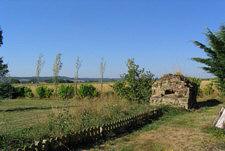
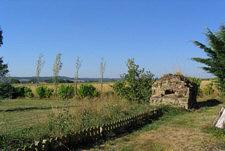
Wheat has been found in pits where human settlements flourished 8,000 years ago. The ancient Greeks and Romans knew bread for a staple food even in those days people argued whether white or brown bread was best.

Further back, in the Stone Age, people made solid cakes from stone-crushed barley and wheat. A millstone used for grinding corn has been found, that is thought to be 7,500 years old. The ability to sow and reap cereals may be one of the chief causes, which led man to dwell in communities, rather than to live a wandering life hunting and herding cattle.

When ancient man discovered a food that would keep through the winter months, and could be multiplied in the summer, it could be said that civilization began. He might have a reasonably safe store of food to carry him over, which would give him time to develop other useful skills besides hunting, fishing and cattle-herding.

Bread was leavened; that is, an agent in the form of a 'barm' was added to the dough that caused the mixture to rise in the shape of our familiar loaf. The hurried departure of the Israelites from Egypt, described in the Book of Exodus in the Bible, prevented their bread being leavened as usual; the Jews today commemorate this event by eating unleavened bread on special occasions.The ruins of Pompeii and other buried cities have revealed the kind of bakeries existing in those historic times. There were public bakeries where the poorer people brought their bread to be baked, or from which they could buy ready-baked bread.
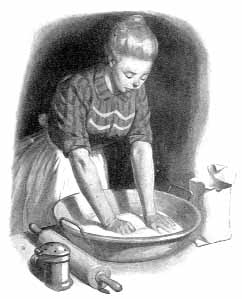
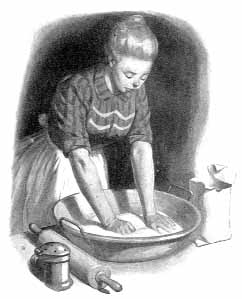
The bakers in Rome at period 168 BC enjoyed special privileges: they were the only craftsmen who were freemen of the city, all other trades being conducted by slaves.

The Greeks and Romans liked their bread white; color was one of the main tests for quality at the time of Pliny (AD 70). Those who think the craze for white bread is a modern fad should note this. Pliny wrote, "The wheat of Cyprus is swarthy and produces a dark bread, for which reason it is generally mixed with the white wheat of Alexandria". Plato (c. 400 BC) pictured the ideal state where men lived to a healthy old age on wholemeal bread ground from local wheat. Socrates, however, suggested that this proposal meant the whole population would be living on pig-food. In those days, there were certain bakers who kneaded the meal with seawater to save the price of salt. Pliny did not approve of this.

The Romans enjoyed several kinds of bread, with interesting names. There was oyster bread (to be eaten with oysters); 'artolaganus' or cakebread; 'speusticus' or 'hurry bread'. There was oven bread, tin bread, and Parthian bread. There were rich breads made with milk, eggs and butter, but these of course, were only for the wealthy and privileged people. The Egyptian grammarian and philosopher Athenaeus, who lived in the third century AD, has handed down to us considerable knowledge about bread and baking in those days.

He wrote that the best bakers were from Phoenicia or Lydia, and the best bread-makers from Cappadocia. He gives us a list of the sorts of bread common in his time-leavened and unleavened loaves; loaves made from the best wheat flour; loaves made from groats, or rye, and some from acorns and millet. There were lovely crusty loaves too, and loaves baked on a hearth. Bakers made bread mixed with cheese, but the favorite of the rich was always white bread made from wheat. In ancient Greece, keen rivalry existed between cities as to which produced the best bread.
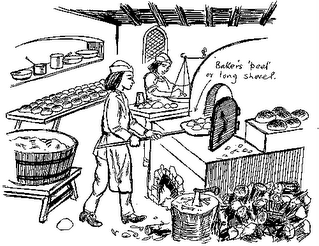
In early English historical times, there were constantly recurring periods of famine, due to not enough, or too much rain, or frosts, and other natural causes. The ruling classes, knowing that rebellion often followed famine, did their utmost to keep the price of bread from rising too high. Laws regulating its price were passed during the reign of King John (1202). Not only did the law fix the price, but also it strictly allocated that price between cost of material and an allowance for necessary charges to the baker.
Food History

THE MOST POPULAR POSTS